

Border Security Market to Reach US$ 76.52 Billion by 2035, Expanding at a CAGR of 6.12% from US$ 41.18 Billion in 2025
Border Security Market
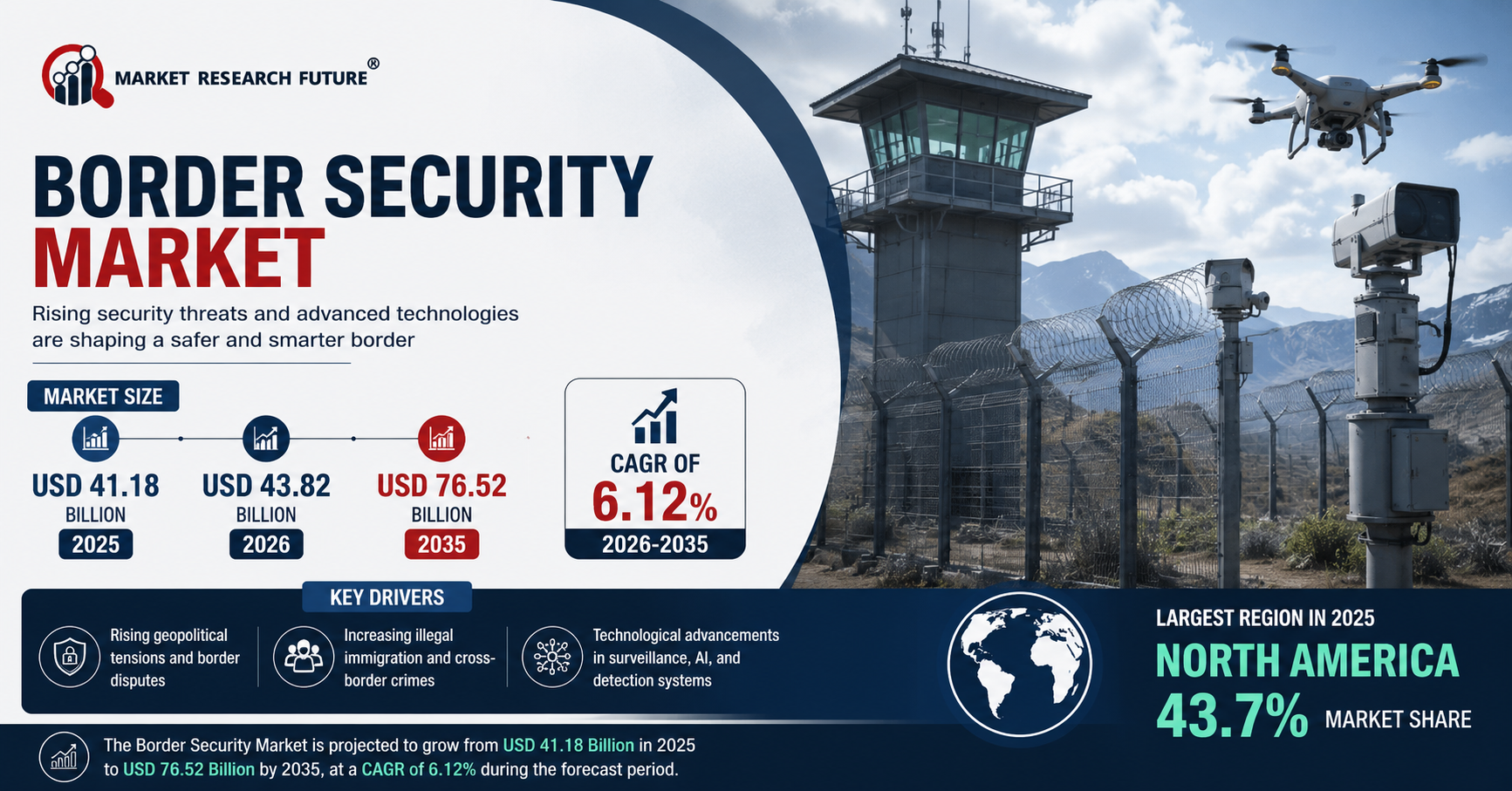
The global Border Security Market is witnessing significant expansion as governments worldwide strengthen national security infrastructure, modernize surveillance systems, and invest in advanced technologies to counter illegal migration, cross-border terrorism, smuggling, and geopolitical threats. According to Market Research Future (MRFR), the Border Security Market was valued at USD 41.18 billion in 2025 and is projected to grow from USD 43.82 billion in 2026 to USD 76.52 billion by 2035, registering a CAGR of 6.12% during the forecast period.
The increasing adoption of artificial intelligence, biometric identification systems, unmanned surveillance platforms, integrated command centers, and real-time threat detection technologies is transforming the way nations secure their borders. Rising defense budgets and growing concerns regarding national sovereignty continue to create favorable conditions for sustained market growth.
Border Security Market Overview:
Border security has become a strategic priority for governments across the globe as security threats continue to evolve. Traditional border monitoring systems are being replaced with intelligent and interconnected security networks that combine sensors, radars, thermal cameras, drones, and AI-powered analytics to provide comprehensive situational awareness.
Modern border security solutions are designed to enhance detection accuracy, reduce response times, and improve operational efficiency. Governments are increasingly deploying integrated systems that combine surveillance, command and control, and threat assessment capabilities to strengthen border protection across land, air, and maritime environments.
The market's growth trajectory is further supported by increasing investments in defense modernization programs and the emergence of smart border initiatives that leverage digital technologies for enhanced border management.
Request Sample PDF of Report: https://www.marketresearchfuture.com/sample_request/1662
Latest Trends Shaping the Border Security Market:
1. AI-Powered Surveillance Systems Gaining Momentum
Artificial intelligence is rapidly becoming a core component of modern border security infrastructure. AI-enabled surveillance systems can analyze massive amounts of data generated by cameras, sensors, and drones in real time, enabling authorities to identify suspicious activities and potential threats with greater accuracy.
Machine learning algorithms are helping security agencies improve intrusion detection capabilities while minimizing false alarms. These intelligent systems can automatically classify objects, track movements, and predict potential security risks.
2. Growing Adoption of Biometric Identification Technologies
Biometric authentication solutions are increasingly being deployed at border checkpoints, airports, and immigration facilities. Facial recognition, fingerprint scanning, iris recognition, and multimodal biometric systems are enhancing identity verification processes while improving security and traveler convenience. The growing emphasis on digital identity management is expected to accelerate the deployment of advanced biometric border control systems globally.
3. Expansion of Unmanned Surveillance Platforms
Unmanned aerial vehicles (UAVs), autonomous ground vehicles, and maritime drones are becoming critical components of border monitoring operations. These systems provide persistent surveillance capabilities and enable authorities to monitor remote or difficult-to-access areas efficiently. The increasing use of counter-UAS technologies to detect and neutralize unauthorized drones is also emerging as a key trend across the market.
4. Smart Border Initiatives Accelerating Worldwide
Governments are increasingly implementing smart border programs that integrate digital technologies, cloud computing, AI, and advanced communication networks. These initiatives aim to create interconnected security ecosystems capable of supporting real-time decision-making and rapid threat response. Smart borders improve operational efficiency while reducing the burden on security personnel through automation and predictive analytics.
5. Integrated Command and Control Systems Becoming Essential
The demand for centralized command and control systems is growing as agencies seek to consolidate data from multiple security assets into a unified operational platform. These systems provide comprehensive visibility and facilitate coordinated responses across various security units.
The integration of surveillance systems, detection technologies, and communication platforms into a single operational framework is expected to remain a major industry trend.
Key Market Drivers:
1. Rising Geopolitical Tensions and Border Disputes
Increasing geopolitical conflicts and territorial disputes are among the most significant factors driving investments in border security solutions. Nations are strengthening border infrastructure to protect territorial integrity and prevent unauthorized intrusions.
Governments are allocating substantial resources toward advanced surveillance technologies, detection systems, and monitoring platforms to address evolving security threats.
2. Growing Concerns Over Illegal Immigration
The rise in illegal migration across several regions has prompted governments to adopt sophisticated border monitoring technologies. Advanced surveillance networks and biometric identification systems are helping authorities manage immigration more effectively while maintaining national security. The need for enhanced border control measures is expected to continue driving demand for modern security solutions throughout the forecast period.
3. Increasing Cross-Border Criminal Activities
The growing prevalence of drug trafficking, human trafficking, smuggling, and organized crime has highlighted the need for comprehensive border protection systems.
Security agencies are increasingly investing in radar systems, sensors, surveillance cameras, and integrated monitoring platforms to detect and prevent illegal activities at border crossings and remote locations.
4. Expansion of Defense Modernization Programs
Many countries are implementing large-scale defense modernization initiatives that include significant investments in border security infrastructure.
These programs focus on replacing outdated systems with advanced technologies capable of addressing modern security challenges. The modernization trend is creating substantial opportunities for technology providers and defense contractors.
5. Technological Advancements in Security Solutions
Continuous innovation in sensors, artificial intelligence, communication technologies, and unmanned systems is enhancing the effectiveness of border security operations.
Advanced technologies are enabling authorities to achieve greater situational awareness, improve operational efficiency, and strengthen threat detection capabilities.
Emerging Opportunities in the Border Security Market:
1. AI-Based Threat Detection Platforms
The increasing demand for intelligent surveillance systems presents significant opportunities for technology providers specializing in AI-driven analytics. These platforms can process vast amounts of security data and provide actionable insights in real time.
2. Advanced Biometric Border Control Systems
Growing emphasis on secure identity verification is creating opportunities for companies developing next-generation biometric technologies. The expansion of e-passports and digital identity programs is expected to support market growth.
3. Counter-Drone Solutions
The increasing use of drones for illegal activities is driving demand for counter-UAS technologies. Detection, tracking, and neutralization systems represent a rapidly growing opportunity area within the border security market.
4. Autonomous Surveillance Networks
The deployment of autonomous surveillance platforms, including drones and robotic patrol systems, is creating new revenue streams for industry participants.
These solutions offer cost-effective monitoring capabilities while reducing operational risks associated with human patrols.
5. Cloud-Based Border Management Platforms
Cloud-enabled border security solutions are gaining traction due to their scalability, flexibility, and ability to support data-driven decision-making.
The integration of cloud computing with AI and IoT technologies is expected to generate significant growth opportunities over the coming years.
Segment Analysis:
1. By Platform
Land Segment - The land platform segment dominated the Border Security Market with a market share of approximately 54.1% in 2025. Land-based border security systems include surveillance towers, sensors, fencing solutions, radar systems, cameras, and integrated monitoring platforms.
The growing need to secure terrestrial borders against unauthorized crossings and criminal activities continues to support segment growth.
Air Segment - The air platform segment is expected to witness strong growth during the forecast period, recording a CAGR of 7.78%.
The increasing use of drones, surveillance aircraft, and airborne monitoring technologies for border security operations is driving demand in this segment. Airborne systems provide enhanced visibility and rapid response capabilities across large geographic areas.
Sea Segment - Maritime border security remains a critical area of focus for coastal nations. The sea segment generated approximately USD 5.14 billion in revenue in 2025. Investments in coastal radar systems, maritime surveillance networks, and autonomous monitoring platforms are expected to support future growth.
2. By Vertical
Military - The military segment accounted for approximately 63.9% of total market revenue in 2025, making it the largest vertical within the Border Security Market. Military organizations continue to invest heavily in advanced surveillance systems, integrated command centers, and detection technologies to strengthen border defense capabilities.
Homeland Security - The homeland security segment is projected to expand at a CAGR of 7.52% through 2035. Government agencies responsible for immigration control, customs enforcement, and public safety are increasingly adopting advanced technologies to improve border management and security operations.
3. By System Type
The Border Security Market comprises several critical system categories, including:
Perimeter Intrusion Detection Systems
Surveillance Systems
Detection Systems
Command and Control (C2) Systems
Counter-UAS Solutions
Among these categories, surveillance and detection technologies continue to attract substantial investments due to their ability to provide real-time monitoring and threat identification. The growing adoption of AI-powered analytics is further enhancing the effectiveness of these systems.
4. By Installation
New Installation - The new installation segment benefits from government investments in greenfield border infrastructure projects and smart border initiatives.
Upgradation - The upgradation segment is gaining momentum as authorities modernize legacy systems with advanced technologies, including AI, biometric authentication, and autonomous surveillance solutions.
Regional Analysis:
North America - North America held the largest share of the Border Security Market, accounting for approximately 43.7% of global revenue in 2025.
The region's leadership position is supported by substantial government spending on border modernization programs, advanced surveillance technologies, and integrated security solutions. The United States remains a major contributor to regional growth through continuous investments in border protection infrastructure.
Europe - Europe represented the second-largest regional market, contributing approximately USD 10.83 billion in 2025.
The region's growth is driven by increasing investments in integrated border management programs, enhanced surveillance capabilities, and cross-border security cooperation initiatives. Continued modernization efforts are expected to support long-term market expansion.
Asia-Pacific - Asia-Pacific is projected to be the fastest-growing regional market, registering a CAGR of 7.82% through 2035.
Rapid border digitization initiatives, rising defense expenditures, and growing geopolitical tensions are encouraging governments across the region to invest in advanced border security technologies. Emerging economies are increasingly adopting smart surveillance systems and integrated security platforms.
Middle East & Africa - The Middle East & Africa region is witnessing growing demand for border security solutions due to regional security concerns, cross-border conflicts, and infrastructure modernization initiatives. Investments in surveillance technologies and integrated command systems are expected to support market growth throughout the forecast period.
South America - South America is gradually strengthening border protection capabilities to address illegal trafficking, smuggling, and organized crime activities. Governments across the region are investing in advanced monitoring technologies and surveillance networks to enhance border management efficiency.
Top Company Profiles:
Elbit Systems - Elbit Systems is a leading provider of advanced defense and security technologies. The company offers integrated border surveillance solutions, command and control systems, intelligence platforms, and autonomous monitoring technologies.
Leonardo S.p.A. - Leonardo specializes in aerospace, defense, and security systems. Its border security portfolio includes radar systems, surveillance technologies, and integrated security platforms designed for land, air, and maritime applications.
Thales Group - Thales Group delivers comprehensive border management solutions encompassing surveillance systems, biometric technologies, command centers, and secure communications infrastructure.
Lockheed Martin - Lockheed Martin develops advanced defense technologies that support border monitoring, intelligence gathering, and threat detection operations worldwide.
Airbus Defence & Space - Airbus Defence & Space provides integrated border surveillance solutions, satellite-based monitoring systems, and secure communication technologies that strengthen border protection capabilities.
Northrop Grumman - Northrop Grumman offers sophisticated surveillance platforms, autonomous systems, and intelligence solutions that support modern border security operations.
General Dynamics - General Dynamics develops mission-critical technologies for defense and homeland security applications, including command and control systems and advanced surveillance platforms.
Raytheon (RTX) - RTX provides radar systems, sensor technologies, integrated defense solutions, and advanced monitoring platforms designed to enhance border security effectiveness.
Recent Developments:
June 2026: The Border Security Market report was updated to highlight the growing deployment of AI-powered border monitoring platforms, biometric border control systems, and integrated perimeter security solutions. Governments worldwide are increasingly investing in smart surveillance infrastructure to strengthen border protection against evolving security threats.
January 2026: The UK Home Office awarded border technology contracts worth approximately £81 million to enhance digital border management capabilities. The initiative focuses on AI-enabled border processing, biometric verification technologies, and cloud-based systems designed to improve security and operational efficiency.
September 2025: European authorities demonstrated next-generation border surveillance technologies in Finland, showcasing autonomous maritime systems, AI-powered analytics platforms, unmanned aerial vehicles, and advanced sensor networks aimed at improving situational awareness across border regions.
Future Outlook:
The Border Security Market is poised for sustained growth as governments continue prioritizing national security and border protection. Emerging technologies such as artificial intelligence, machine learning, biometric authentication, autonomous surveillance systems, and cloud-based command platforms will play a crucial role in shaping the industry's future.
With the market expected to grow from USD 41.18 billion in 2025 to USD 76.52 billion by 2035 at a CAGR of 6.12%, industry participants are well-positioned to benefit from increasing investments in smart border infrastructure and advanced security technologies. As security threats become more complex and dynamic, the adoption of integrated and intelligent border security solutions will remain a key strategic priority for nations worldwide.
Browse More Reports:
Border Security System Market
https://www.marketresearchfuture.com/reports/border-security-system-market-31490
Automated Border Control Market
https://www.marketresearchfuture.com/reports/automated-border-control-market-4662
Border Surveillance Market
https://www.marketresearchfuture.com/reports/border-surveillance-market-4028
Sagar Kadam
Market Research Future
+ +1 628-258-0071
sales@marketresearchfuture.com
Visit us on social media:
LinkedIn
Facebook
YouTube
X
Legal Disclaimer:
EIN Presswire provides this news content "as is" without warranty of any kind. We do not accept any responsibility or liability for the accuracy, content, images, videos, licenses, completeness, legality, or reliability of the information contained in this article. If you have any complaints or copyright issues related to this article, kindly contact the author above.
